board.track_width
a copper track's width on a net (millimetres)
What it is 
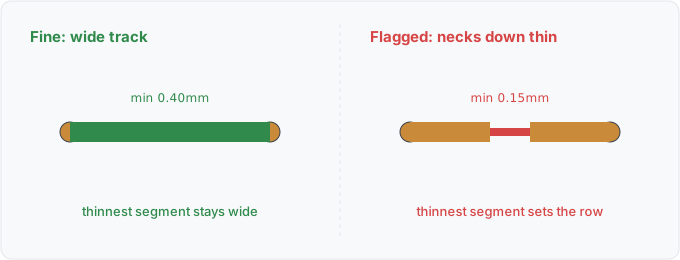
board.track_width(net, mm) yields one row per net that has routed copper, giving the net’s
MINIMUM track width in millimetres. net is the net name (the join key to ir.Net.name); mm
is a number, so a query can compare it directly (?w < 0.2). A net routed with several widths
reports only its thinnest segment, not every segment.
For hardware engineers 
The narrowest copper on a net sets its worst-case current-carrying capacity, so that is the number a review cares about. A power or ground net that necks down to a thin trace somewhere is a current-density risk even if most of its copper is wide. Query this to find nets routed below a width floor, or to sanity-check that a high-current rail never drops under its intended minimum. The value is the physical track width, so the threshold you compare against is a real millimetre figure.
For software engineers 
The routed net is a set of track segments, each with a width. board.track_width is an aggregate
projection over that set: a reduce to the minimum width, keyed by net. Reporting the minimum (the
safety-relevant extreme) rather than one row per raw segment keeps the relation a compact per-net
answer rather than a full segment dump. Rows are 1:1 with nets that have at least one track; a net
with pads or vias but no routed track contributes no row. The stored unit is nanometres; the
projector converts to millimetres so a query reads a natural threshold.
Go projector 
boardFacts in check/facts.go walks Model.BoardNets() and, for each net, calls the helper
minSegmentWidthNm(bn.Segments), which returns the smallest Width across the net’s track
segments (and a false ok when the net has no segments, in which case no row is emitted). The
nanometre minimum is converted with nmToMM and emitted as board.track_width(net, mm) with the
numeric value populated for comparison.
The board tier is EMPTY on a netlist-only design. Model.BoardNets() returns nothing unless the
design was loaded with board geometry (NewModelWithBoard, fed a .kicad_pcb or IPC-2581 board
sidecar). For a query this is silent-by-construction: board.track_width yields zero rows on any
design without board geometry, the same posture the datasheet tier takes without --params. A
query returning nothing does not mean every track is wide; it can mean the design carries no board
at all.
Datalog 
Every net and its minimum track width:
board.track_width(?n, ?w) => ?n, ?w
Nets whose thinnest track drops below 0.2 mm:
board.track_width(?n, ?w), ?w < 0.2 => ?n, ?w
Both need a board-bearing design (a .kicad_pcb or an IPC-2581 file); on a netlist-only load they
return nothing.
Schematic