bus
a reader-detected bus not yet expanded into member nets (WS1-034)
What it is 
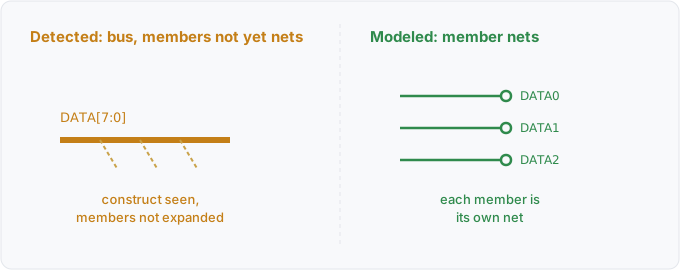
bus(label, kind) yields one row per bus construct a reader detected in the source but has not yet
expanded into member nets (WS1-034 Phase 1). label is the source’s bus name (a KiCad bus-alias
name, an xschem DATA[7:0] label, an EDIF array port name), empty for an anonymous bus wire.
kind is the source construct token that was seen (bus, bus_entry, bus_alias, geda_bus,
edif_array, xschem_bus_label), so a query can filter to one construct.
This is a detect-and-flag relation, not a defect report. The reader saw a bus and recorded it so that silence would not read as “no bus here”. A row means the construct is not fully modeled yet, not that the design is wrong.
Distinct from net.bus_like(net), which reports a solved net whose electrical role is
shared-distribution (a ground plane, a global rail, or rail-scale fan-out). bus is about a
source-file token the reader has not expanded; net.bus_like is about a net that already exists
and passed a fan-out/role predicate. Different concepts, similar names.
For hardware engineers 
A bus is schematic shorthand for a group of related signals drawn as one thick line (DATA[7:0],
ADDR[15:0]) with the members broken out at bus entries. The reader recognised the bus notation
but has not yet split it into the individual member nets it stands for. You query bus during a
review to see which bus constructs a design uses and which reader saw them, so you know where the
connectivity model is still coarse. A row is a coverage note, not an error: the members may be
correct on the sheet and simply not expanded in the read yet.
For software engineers 
This is a syntactic marker the parser emitted for a construct it recognised but did not fully lower
into the connectivity graph. Think of it as a TODO the front end records when it encounters syntax
it can tokenize but not yet desugar, so the omission is visible instead of silent. It is a
projection over Model.UnmodeledBuses(), so rows are 1:1 with detected bus constructs. An empty
result means the read found no bus notation (or a later phase has modeled every one), not that the
design has no shared-distribution nets. For those, query net.bus_like.
Go projector 
busFacts in check/facts.go iterates Model.UnmodeledBuses() (which returns the reader-emitted
ir.BusNotModeled list off InputDiagnostics) and emits one bus(label, kind) row per entry, with
the construct’s provenance as the citation. One row per detected bus construct; empty for a design
whose read detected no bus notation. Every reader populates the same channel, so the relation is
format-neutral.
Datalog 
List every detected bus and its construct kind:
bus(?label, ?kind) => ?label
Filter to one source construct (here, gEDA buses):
bus(?label, "geda_bus") => ?label
Schematic