feedback
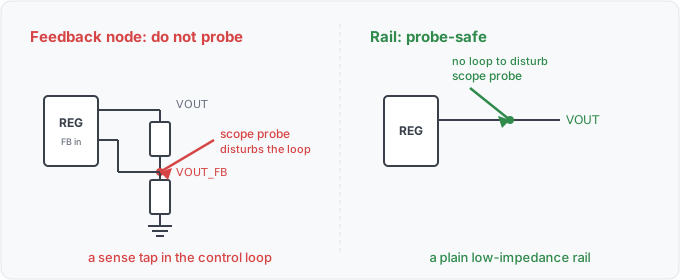
the net is a regulator feedback / sense node (must not be probed)
What it is 
feedback(net) yields one row per net whose name reads as a regulator feedback or sense node: a
leaf name ending in _FB, _VFB, _FEEDBACK, _VSENSE, _SENSE, _SNS, or a bare FB / VFB.
It is name-derived, the datalog face of the feedback exclusion the test-point rule applies.
For hardware engineers 
A feedback net is the divider tap that feeds a switching or linear regulator’s control loop. It is a
high-impedance sense node, so anything you hang on it changes the voltage the regulator reads and
shifts regulation. That is why a scope probe or a test point on a feedback node is a review finding:
the probe’s capacitance and loading disturb the loop it is measuring. During a review you query
feedback to list the sense nodes, and you subtract it from rail so a probe-point or pull-up rule
does not treat a sense tap as an ordinary rail.
For software engineers 
Think of a feedback net as a node you may read but must not tap: observing it changes its value, so
it is off-limits to the instrumentation a normal rail allows. feedback is a filtered projection
over Nets() with the naming predicate, so rows are 1:1 with feedback-named nets, and an empty
result means no net name matched the sense-node lexicon.
Go projector 
feedbackFacts in check/facts.go walks Model.Nets() and emits a row for each net where
isFeedbackName(name) holds. isFeedbackName (in check/rolenames.go) delegates to the active
naming lexicon’s IsFeedback, matching the _FB / sense-suffix patterns on the hierarchy leaf,
case-insensitive. One row per feedback-named net; empty when no net matches.
Datalog 
List every feedback / sense node:
feedback(?n) => ?n
A supply rail that is not a sense node (the rails a probe or pull-up rule may treat as ordinary distribution):
rail(?n), not feedback(?n) => ?n
Schematic