param.range
a datasheet parameter's two-sided limit with its kind, both bounds in the SI base unit (absolute_max / recommended_operating / characteristic; needs --params)
What it is 
param.range(mpn, symbol, kind, min, max) yields one row per parameter of a datasheet spec that
joined to a part in the design, keyed by manufacturer part number (mpn) and the parameter’s
datasheet symbol (e.g. VDD, VIN). Unlike the thin param(mpn, symbol, max), each row carries
BOTH bounds, the lower min and the upper max, and the kind token that says which limit table
the row came from: absolute_max, recommended_operating, or characteristic (unspecified when
the source did not label it). A bound the datasheet did not state is ABSENT: the argument still binds,
to a value marked absent, so a max-only row still appears in a listing and the relation never shortens
its own answer. What an absent bound cannot do is take part in an ORDERING comparison, and
absent(?min) selects exactly those rows. This text used to say the argument “binds to nothing”,
which was never true. It bound to the empty string, and an ordering comparison then answered by
string order, where "" precedes every number.
BOTH bounds are in the parameter’s SI base unit whatever the vendor printed, so a range test means the
same thing across vendors; join param.unit for the printed spelling, and note that a parameter whose
unit has no known scale appears here with both bounds absent (agni issue 165). Every row carries a
citation back to the datasheet page and table.
This is the datasheet tier of the query surface. It is EMPTY unless agni is run with
--params <dir> pointing at a seeded PartSpec corpus, so it is skip-not-false-pass by construction: with
no corpus loaded the relation yields zero rows and every rule that reads it reports not-applicable
rather than a false pass.
For hardware engineers 
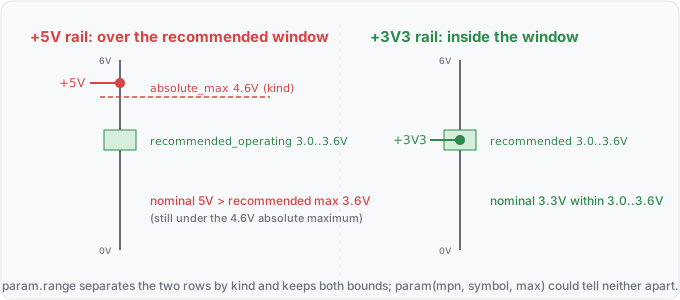
A row is one line off a part’s limits table, with the table it came from named. The distinction
param cannot make is the whole point here: a part often prints VDD twice, once as an absolute-maximum
(exceed it and you may destroy the part) and a recommended-operating window (run outside it and the
guaranteed specs no longer hold). param(mpn, "VDD", max) collapses both into indistinguishable
rows; param.range keeps them apart by kind and gives you both ends of the recommended window, so
you can ask “is this rail inside the recommended range” (a two-sided question) rather than only “is it
under the absolute ceiling”. As with param, values are presented, not silently coerced: a row whose
conditions survive only as free text is not machine-comparable and is shown beside its citation.
For software engineers 
param.range is param with the type widened from a single ceiling to a {kind, min, max} triple.
Where param answers “what is the max”, param.range answers “what KIND of limit, and what is its
window”. The design-side identity is still component.mpn(ref_des, mpn), so the join is unchanged;
you gain the ability to filter by kind and to bound-check against min as well as max. That is
exactly what a two-sided range rule needs: join component.mpn to param.range(?m, ?s, "recommended_operating", ?min, ?max), bring in the design’s rail voltage via net.nominal_voltage,
and flag ?v > ?max or ?v < ?min. The thin param relation is kept for back-compat and simple
max search; param.range is the superset a limit-kind-aware rule reads.
Go projector 
paramRangeFacts in check/facts.go iterates Model.Components(), reads each component’s MPN via
Model.ComponentMPN and its spec via Model.PartSpec, dedupes by MPN, and emits one row per
spec.Parameters entry. Value is the kind token (limitKindToken), Min is Value.Min and Num
is Value.Max (each nil when the datasheet omitted that bound), and Cite is the datasheet
provenance. It shares the join and dedup shape of paramFacts; the two differ only in which fields
they surface. Empty without --params.
Datalog 
Both queries need --params. List every recommended-operating window for each part, as MPN, symbol,
and bounds:
param.range(?mpn, ?sym, "recommended_operating", ?min, ?max) => ?mpn, ?sym, ?min, ?max
Cross to the design and flag a rail sitting above a part’s recommended maximum, the two-sided,
kind-discriminated join the thin param relation could not express:
component.mpn(?ref, ?mpn), param.range(?mpn, ?sym, "recommended_operating", ?min, ?max),
component-on-net(?ref, ?net), net.nominal_voltage(?net, ?v), ?v > ?max => ?ref, ?net, ?v, ?max