pin.role
a pin's derived role (power/ground/anode/cathode)
What it is 
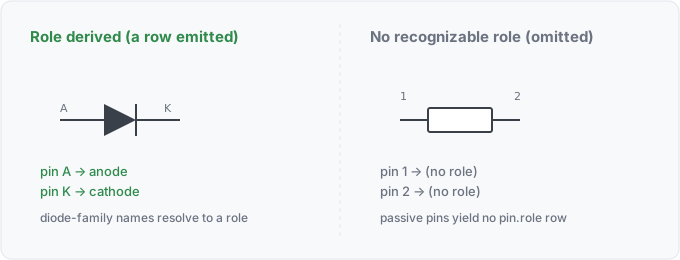
pin.role(ref_des, pin, role) yields the derived semantic role of a pin, where role is one of
power, ground, anode, cathode, gate, source, or drain. The role is inferred from the pin’s declared name, gated
by the component’s device class. A row is emitted only when a role is derived; a pin whose role
cannot be determined produces no row (the role is never guessed).
For hardware engineers 
This is the tool reading a pin’s name the way you would: VCC/VDD on any part is a power pin,
GND/VSS is ground, and A/K on a diode-family part are anode and cathode. The polarity
roles are class-gated on purpose. A pin named A on an IC is a signal, not an anode, so anode and
cathode are derived only for diodes, LEDs, TVS, and Zeners.
gate, source and drain (WS3-117) are gated the same way and for a sharper version of the same
reason: they are the shortest pin names on a board. A bare G, S or D means something on almost
every part, so they are derived only where the class lexicon reads the component as a transistor,
and the patterns are whole-name anchored so SDA is not a source and DIR is not a drain. A wrong
role is worse than a missing one here, because a topology rule would then walk a path that does not
exist and report on it.
Unlike the polarity tokens, the terminal roles read from the naming lexicon rather than engine
literals, so a house that calls its gate DRV declares that under lexicon.pin.gate in --conventions
instead of patching the engine. Matching is exact-token, not substring:
CLKA is not an anode. You query it to find, say, every cathode and check where it lands, or to
confirm the polarity roles resolved on the parts you expect.
For software engineers 
pin.role is a derived tag over the pin member: not a stored field, but a classification
computed from the pin name plus the owning instance’s class. Rows are at most 1:1 with a pin, and
only for pins that classify. An absent row means the role is unknown, the honest default. This
“omit when unknown, never guess” shape is why a query counting roles never sees a phantom
unknown value: the projection simply skips it.
Go projector 
pinFacts in check/facts.go calls Model.PinRole(ref, des) for each pin and emits a
pin.role(ref_des, pin, role) row only when the result is not RoleUnknown. PinRole runs
classifyPinRole, which upper-cases the pin name, applies the anode/cathode vocabulary when the
component class is in the diode family (diode, led, tvs, zener), and otherwise maps
ground-names to ground and rail-names to power. At most one row per pin; empty when no pin
carries a recognizable role name (or the design has no part-pin data).
Datalog 
Every pin with a derived role:
pin.role(?r, ?p, ?role) => ?role
Join to pin.net to find the net each cathode lands on (the polarity roles gated to the diode
family):
pin.role(?r, ?p, "cathode"), pin.net(?r, ?p, ?n) => ?n
Schematic