pin_net_conflict
a pin the read placed on more than one net; one row per net (reader integrity diagnostic)
What it is 
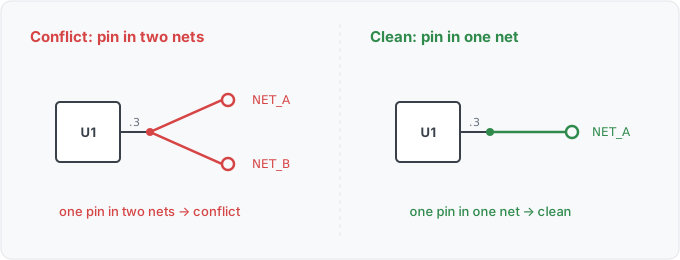
pin_net_conflict(ref_des, pin, net) yields one row per net that a single (ref_des, pin) was
placed on when the read put that pin on more than one net. Because a pin belongs to exactly one
net by definition (a net is the equivalence class of joined pins), any pin that appears in two
nets is malformed input, a reader bug or a corrupt export, not a design a person drew. The
multi-row shape (one row per claiming net) lets a query name every net the conflicted pin touches
and join to those nets.
This is the query-relation face of the pin-net-conflict integrity rule: the rule fires a
finding, the relation lets you interrogate the same condition ad hoc.
For hardware engineers 
You should almost never see this. A pin is one physical node; it cannot legitimately be part of two separate nets at once. When it shows up, the tool’s read of the file disagreed with itself. Its first corpus runs surfaced two reader gaps (unannotated placeholder refs merged, WS1-024; duplicate port designators collapsed, WS1-025). Treat a row as “fix the read,” not “fix the board.”
For software engineers 
A net is an equivalence class over pins, so membership should be a function: each pin maps to
one net. This relation reports the keys where that function became one-to-many, the invariant
break behind every per-pin answer downstream (pin.net, diff keys, viewer highlights). Rows are
1:many with the offending pin (one per claiming net); an empty result means the read is clean and
every pin resolved to a single net.
Go projector 
pinNetConflictFacts in check/facts.go iterates Model.PinNetConflicts() and, for each
conflicted pin, emits one row per net in its Nets list. Empty when the read is clean. A pin of a
collided ref-des is not reported here, since that root cause belongs to the duplicate-ref-des
finding, so one authoring slip yields one finding, not two.
Datalog 
Every conflicted pin and the nets claiming it:
pin_net_conflict(?r, ?p, ?n) => ?r
Join to the components on each claiming net (what else the malformed read tangled together):
pin_net_conflict(?r, ?p, ?n), component-on-net(?other, ?n) => ?other
Schematic