ref_des_collision
a reference designator used by more than one part (reader integrity diagnostic)
What it is 
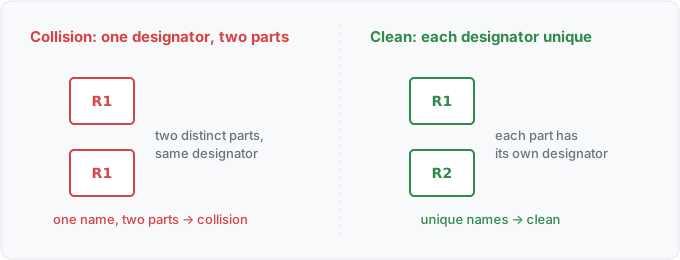
ref_des_collision(ref_des) yields one row per reference designator that more than one distinct
part claimed. A designator names exactly one physical part (R1 is one resistor on the board), so a
designator shared by two placements is malformed input, a reader gap or a duplicate in the source,
not a design a person drew. The relation is keyed by ref_des so a query joins the collision to the
components and nets it tangles.
This is the query-relation face of the duplicate-ref-des integrity rule: the rule fires a finding,
the relation lets you interrogate the same condition ad hoc.
For hardware engineers 
You should almost never see this. A reference designator is the one label that lets a person point
at a single part across the schematic, the layout, and the BOM. Two parts both called R1 cannot be
told apart, so a row means the tool’s read of the file collapsed two placements that should have
stayed separate, or the source itself repeated a designator. It is not the legitimate multi-unit
case: a dual op-amp drawn as U1A and U1B stays one component with two sections and does not
collide. Treat a row as “fix the read (or the source),” not “fix the board.”
For software engineers 
A reference designator is the instance’s variable name (see ANALOGY.md), so the designator set should behave like a symbol table with unique keys. This relation reports the keys that got a second binding, the same duplicate-declaration break a linter flags when one identifier is defined twice in one scope. Rows are 1:1 with colliding designators (one row per shared name, regardless of how many placements claimed it). An empty result means every designator resolved to a single part, the normal state.
Go projector 
refDesCollisionFacts in check/facts.go iterates Model.RefDesCollisions() (the reader-emitted
ir.RefDesCollision list off InputDiagnostics, where each reader decides duplicate-versus-legitimate
by its own format’s rule) and emits one ref_des_collision(ref_des) row per collided designator. The
citation is the first colliding instance. One row per shared designator; empty when the read is clean.
Datalog 
Every colliding designator:
ref_des_collision(?r) => ?r
Join to the nets each colliding designator sits on (which nets the tangled read connected together):
ref_des_collision(?r), component-on-net(?r, ?n) => ?n
Schematic