bulk-cap
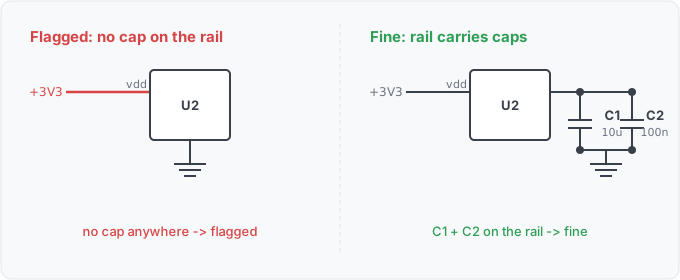
A named power rail carries no capacitor at all (no bulk reservoir).
Remedy 
Add a bulk reservoir capacitor where the rail enters, sized from the load step the rail has to absorb and from the regulator’s own stability requirement.
What it means 
Every named power rail (a net an author gave a power symbol or asserted with a power flag) should carry at least one capacitor.
Why engineers want it 
Decoupling is per-pin; bulk capacitance is per-rail. A rail with literally no capacitance sags on every load step, and LDO datasheets require an output capacitor for loop stability. This is the aggregate per-rail complement to decoupling-present.
Impact 
Rail droop under transients, regulator instability, resets that only reproduce under real load patterns.
Scope note 
Rail identity is the global / power_driven net facts (power symbols and power flags), not pin directions, so a rail feeding only passives is still covered; decoupling-present quantifies over power-input pins instead, and the two deliberately overlap on a rail that has power pins and no caps. Ground-named nets are excluded (capacitors land ON ground from every rail; “ground has no bulk cap” is not a defect), and unresolved external nets are skipped (the cap may live in an unread sheet). Distinguishing bulk from local decoupling by value is a datasheet-joined refinement (WS10).
Query structure 
select rails by fact, require a capacitor member.
select N in nets where (global(N) or power_driven(N)) and not ground_name(N)
  and not exists P in N.connections where class(P) == capacitor
Reads: component.class, net.attributes (global, power_driven, external), net.names (the ground-name skip), on_net. Tier R.