bus-not-modeled
A bus's member signals are not resolved into distinct nets.
Remedy 
Resolve the bus into its member nets, usually by labelling each member at its tap or by declaring the bus on its hierarchical port. Until then, connectivity over those signals is unmodelled and any diff or highlight across them is unreliable.
What it means 
A bus on the schematic has member signals that are NOT all resolved into distinct nets. The bus may
be a gEDA U segment, a KiCad range-bus label, an xschem NAME[n:0] label, or an EDIF array
port. It names a set of members. A range DATA[7:0] expands to DATA0..DATA7, and KiCad spells it
DATA[0..7]. The finding fires when one or more of those members is not a net in the read, or when
the reader could not determine the members at all.
Why engineers want it 
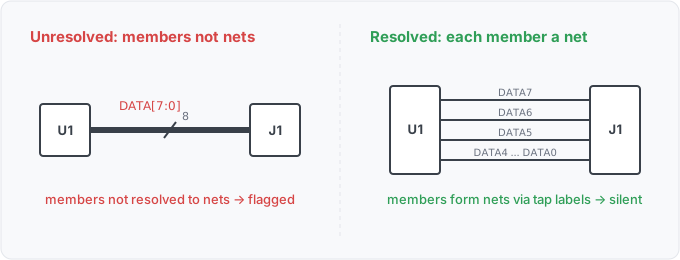
A bus is a drawing shorthand, where one line stands for many signals. Every downstream answer, such as a diff, a rule or a highlight, needs each member to end up as its own net. On a flat sheet that already happens. KiCad requires a member label on every bus tap, so the members form nets by name and the bus is effectively modeled. The finding is SILENT there. It fires where the members are genuinely unresolved, so the read-gap is visible instead of silent.
Impact 
Corrupt or missing connectivity for the unresolved members, with no other symptom until a rule misfires or a diff lies. Info severity because the cause is the reader, not the design.
Members are matched by name 
Resolution is checked by member NAME. A flat sheet’s member labels are bare
(DATA0), so they match the bus’s expanded members and the bus reads as resolved. A hierarchy read
qualifies a sheet-local member net per instance (/amp1/DATA0). That name does NOT match the bare
DATA0, so the rule correctly flags a bus whose members do not cross a sheet boundary (a
hierarchical bus port). In that case connectivity really is lost. We verified this against
kicad-cli sch export netlist. A flat bussed sheet produces exactly the member nets, so the rule
is silent on it.
Scope note 
A KiCad bus_alias declaration is a member list, not a bus. Its members become nets only as
PREFIX.MEMBER where a group bus (I2C7{I2C}) uses it, so the declaration is not checked.
Checking it by its bare member names fired on every alias of the Jetson baseboard (agni issue 939).
Group buses are not checked either, since KiCad lets a group leave members unbroken-out.
The rule detects a bus and checks its members, and stops there. WS1-034 still has to EXPAND a bus across a sheet boundary (a hierarchical bus port) into crossing member nets. Until then this rule flags those cases rather than silently mis-reading them. Drawing the bus trunk is the renderer’s job (WS7-042).
Query structure 
report each bus whose members are not all present as nets.
select B in unmodeled_buses where exists M in members(B) : not net_exists(M)
Reads: bus.construct (a reader diagnostic), net.names. Tier P.