cap-voltage
A capacitor's datasheet rated voltage does not clear the worst rail it touches times the derate factor.
Remedy 
Fit a capacitor rated above the worst rail it touches, with the derating the design’s own rules call for. On ceramics, allow for the capacitance lost under applied DC bias as well.
What it means 
A component classed as a capacitor, joined by MPN to a seeded datasheet
spec carrying a rated voltage (VDC/WV/VR-family symbol or a “Rated Voltage” row), sits on a
rail whose declared voltage times the derate factor (1.25) exceeds that rating.
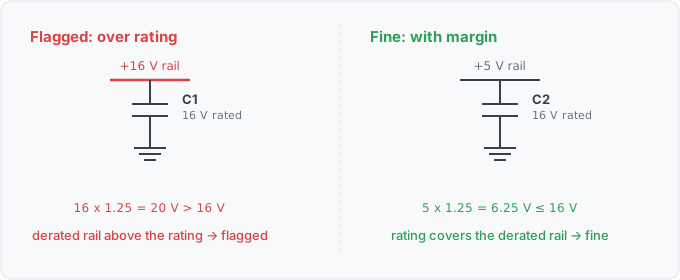
Why engineers want it 
This is the stakeholder-named cap-voltage rule: the classic review checklist item (“is every cap rated for its rail, with margin?”) turned into a check whose limit is the vendor’s number with provenance, not a rule-of-thumb constant in code. The finding cites the datasheet page/table so the margin is verifiable, on the datasheet layer’s whole posture (docs/20).
Evidence honesty 
Every untrusted input is a skip, never a guess: no MPN / unseeded MPN / no seeded corpus; no machine-comparable rated-voltage row (docs/20 comparison semantics); units other than “V”; a rail with neither a max_voltage attribute nor a name-derived nominal. The worst (highest) known rail among the cap’s nets governs.
Query structure 
Spec-authored (docs/19 “a rule is a value”); the join and float compare live in the cap_voltage_detail SpecFunc, which returns the violation sentence or “”, so the rule body stays AST and the derived Reads carry the param join as named relations.
select C in components where class(C) == capacitor
  and cap_voltage_detail(C) != ""    // Vrated < worst_rail_V x 1.25, seeded and comparable
Reads: param.cap_rated_voltage, net.max_voltage, component.mpn, component.class, on_net. Tier R.