crystal-load-caps
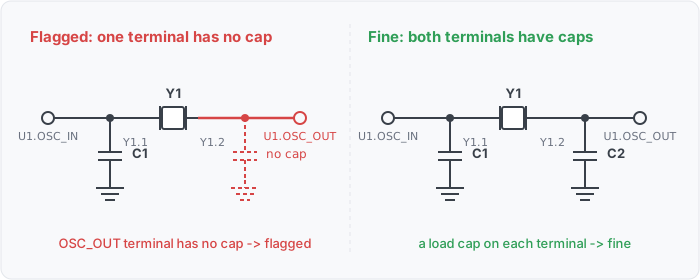
A passive crystal has an oscillator terminal with no load capacitor to ground.
Remedy 
Fit a load capacitor from each oscillator terminal to ground, sized from the crystal’s specified load capacitance and the stray capacitance of the layout rather than copied from another design.
What it means 
A passive quartz crystal (a two-terminal resonator, ref-des Y/XTAL) needs a load
capacitor from each of its two oscillator terminals to ground. This rule flags a crystal
terminal that carries no capacitor.
Why engineers want it 
A crystal is specified for a nominal LOAD CAPACITANCE (C_L), and the two load caps plus
the board stray capacitance are what present that load. With a load cap missing the
oscillator sees the wrong load: it may fail to start, start only sometimes across
temperature, or run off its rated frequency. Everything clocked from it drifts with it, so
the defect surfaces as flaky UART/USB/CAN timing rather than an obvious “no clock”.
Impact 
Oscillator no-start or off-frequency operation; timing-dependent field failures that pass bench bring-up.
Scope note 
The rule quantifies over crystal COMPONENTS, not nets, because “which terminals” and “is
this an active oscillator” are both cross-net facts about the one part. A crystal that
connects to a non-ground POWER RAIL is treated as an ACTIVE oscillator (a packaged XO with
a Vdd pin, which supplies its own load internally and takes no external caps) and is
skipped entirely, so the rule never demands load caps of the wrong device. Ground-named
terminals (the grounded case pins of a 3- or 4-pin crystal) are not signal terminals and
are excluded. An unresolved external net is skipped (the cap may live on an unread sheet),
matching the decoupling-present / bulk-cap external-skip convention. The load-cap VALUE
(does 2*(C_L - C_stray) match the crystal’s spec) is a datasheet-joined refinement
(WS10), out of scope here: this rule checks PRESENCE, not value.
For software readers 
Think of the crystal as a component with a hard runtime dependency that the type system can’t express: it only works when two specific companion parts (the load caps) are wired to it. This is a static “is the required dependency present on this node” check, the same shape as decoupling-present (“does this power rail have its bypass cap”). The active-XO skip is a guard clause: an active oscillator is a different type that satisfies the dependency internally, and we detect it structurally (it has a power pin) rather than by trusting a name.
Query structure 
select crystals; for each, gather non-ground terminal nets and whether it has a power pin; skip if powered; require a capacitor on each terminal net.
for Y in components where class(Y) == crystal:
  terms   = nets(Y) where not ground(net)
  powered = any net(Y) is a non-ground power rail
  if powered: continue
  for N in terms where not external(N):
    if not exists P in N.connections where class(P) == capacitor: FIRE(Y, N)
Reads: component.class, net.attributes (external), net.names (the ground / power-rail skip), on_net. Tier R.