dangling-endpoint
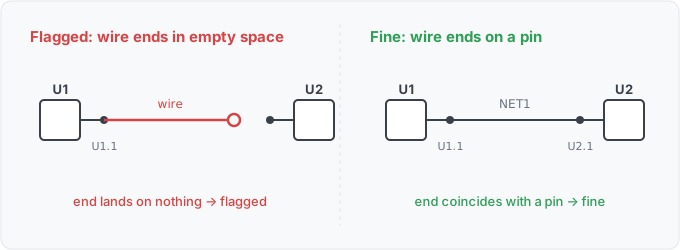
A wire endpoint terminates on nothing (no pin, junction, label, or other wire).
Remedy 
Extend the wire to the pin, junction, or label it was meant to reach, or delete it. A wire that ends in space is never what the author intended.
What it means 
A schematic wire whose end lands on empty space: no pin, no junction dot, no label, and no other wire endpoint sits at that point. The author drew a connection and stopped a hair short, so the wire connects nothing.
Why engineers want it 
A .kicad_sch (and xschem/gEDA) stores connectivity as geometry: two things connect only when their points coincide. A wire dropped a grid step away from a pin looks connected on screen but is not. This is the geometric sibling of single-pin-net: single-pin-net catches a net wired to one pin, this catches a wire wired to zero, a link that never became a net at all, so no net-level rule can see it.
Impact 
The connection the author meant to make is missing, and nothing downstream reveals it because the wire produced no net. Every ERC ships a dangling-end check for exactly this reason.
Scope 
Endpoint-on-nothing only. The disguised sibling, a wire end landing mid-span on another wire’s body with no junction dot, is wire-no-junction (WS1-012).
Query structure 
the reader computes the dangling endpoints from wire geometry; the rule reports them.
select E in dangling_endpoints
Reads: wire.endpoint, wire.junction. Tier P.