diff-pair-naming
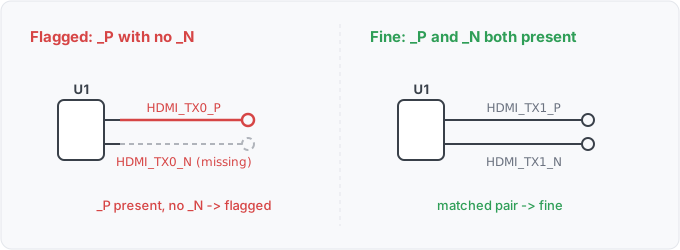
A differential-pair positive net (_P / _DP / trailing +) has no complementary negative net.
Remedy 
Add the missing complementary net, or rename the net if it was never half of a pair. Left as it is, the layout tool routes the two as ordinary signals and the link is not a differential pair at all.
What it means 
A net named as the positive half of a differential pair (a “_P”, “_DP”, or trailing “+” suffix) must have a matching negative half ("_N", “_DN”, or trailing “-”).
Why engineers want it 
High-speed signals travel as complementary pairs, and the naming convention is how the pair is declared to every downstream tool that must route the two nets together with matched length. The two halves are authored separately, and nothing but the name ties them, so a typo or a deleted net silently breaks the pair.
Impact 
The layout tool never couples the two nets, so they get routed like ordinary signals and the link fails signal integrity.
Positive-anchored on purpose 
Detection anchors on the positive member. A lone “_N” suffix is ambiguous with active-low signals (RESET_N, WE_N), so treating every “_N” as an orphaned pair half would fire on the most common real naming convention. A positive suffix does not carry that ambiguity. The cost is that a stray negative with no positive is not reported, which is acceptable for a first rule.
Only when the design uses the convention 
The rule fires only on a design that shows it uses differential-pair naming at all, i.e. at
least one complete pair (some X_P with a matching X_N) exists somewhere. A suffix like
_P is weak evidence on its own: combinational netlists (the LGSynth benchmark family, for
example) carry hundreds of _P-suffixed signal names that are not differential, and without
this gate every one of them is a finding. Requiring pair-population evidence takes those
designs to zero while a real board, which does declare complete pairs, still surfaces its
broken ones.
The cost is a design whose only differential pair is itself broken (one X_P, no X_N, and
nothing else paired) stays silent. That is the same weak-signal case, so the trade is
deliberate. An operator who wants a stricter policy can add a naming convention via
--conventions.
For software readers: this is the difference between “the string ends in _P” and “this
codebase uses a _P/_N pairing convention that this one member violates.” The second is
only a bug if the convention is in use.
Query structure 
Gate on pair-population evidence, then select the positive-suffix nets whose expected complement is absent.
diff_convention_present(design)
  and select N in nets where is_pos_diff(N) and not has_net(expected_negative(N))
Reads: net.names. Primitives: pattern (the suffix), pair (the P-to-N lookup and the convention-present check). Tier R.