duplicate-ref-des
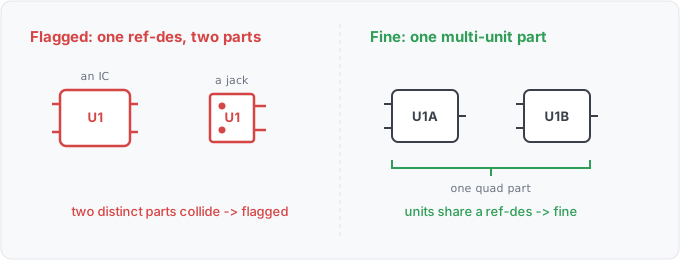
A reference designator is claimed by more than one distinct physical part.
Remedy 
Re-annotate the schematic so each physical part holds its own designator, then re-check the BOM, since whichever part was silently merged is the one to look at first.
What it means 
One reference designator (U1, R5) assigned to two genuinely distinct physical parts, as opposed to the legitimate case of one multi-unit part whose gates share a ref-des.
Why engineers want it 
A duplicated ref-des is a common annotation slip. The two parts merge into one BOM line (one gets built, the other silently omitted) and their connections collide on the same net-join key, so the netlist is quietly wrong. Every capture tool’s ERC flags it.
Why this is a reader diagnostic, not an IR check 
The IR keys components by ref-des and folds a multi-unit part into one component with sections (WS1-001), so by the time the netlist exists the collision is gone and a duplicate is indistinguishable from a multi-unit part. Only the reader, at ingestion, can tell them apart using its format’s own rule (KiCad: the same unit claimed twice). It records the verdict in InputDiagnostics.RefDesCollisions; this rule only reports it (docs/19, “Where a rule runs”).
What it means when this rule does not run 
A rule that only reports a reader’s verdict has nothing to say when the reader never reached one, and “nothing to say” is what a clean design also looks like. So a reader states whether it computed the diagnostic (InputDiagnostics.supplied), and this rule is gated to not-applicable where it did not, rather than reporting a pass nobody earned (agni issue 309).
| Format | Detects | Rule reads |
|---|---|---|
| KiCad | the same unit claimed twice | a real result |
| gEDA | the same slot claimed twice, or two unslotted placements sharing a designator | a real result |
| xschem | a repeated instance name, which the format declares unique | a real result |
| IPC-2581 | a repeated refDes, with no gate construct to group placements | a real result |
| EDIF | nothing: a multi-gate part is instances sharing a designator with no unit to tell them apart | not applicable, with that reason |
An EDIF design is the case worth understanding. The gap is the format’s, not the reader’s: detecting a collision there would mean reporting every multi-gate part as a duplicate. Not-applicable is the honest answer, and it is now the answer a report shows.
Query structure 
report each collision the reader recorded.
select C in ref_des_collisions
Reads: ref_des_collision. Tier P. Site: diagnostic (reader-detected).