input-protection
A connector feeds a power-input pin directly with no fuse or TVS in the path.
Remedy 
Put a fuse and a clamp in the path between the connector and the rail: a fuse for the sustained fault, a TVS for the transient.
What it means 
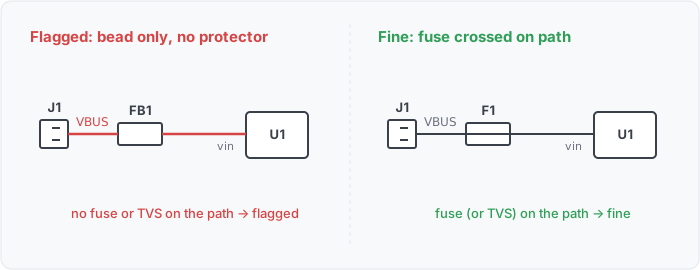
A net where a board connector directly meets a power-input pin must also carry a protection device: a fuse or a TVS.
Why engineers want it 
The power entry is the one net every external fault arrives on. Review checklists ask for a fuse (overcurrent) and a clamp (transient) between the jack and the first regulator; forgetting them is invisible until the wrong charger shows up.
Impact 
Shorted loads burn traces or supplies instead of opening a fuse; hot-plug and ESD transients reach the regulator input unclamped.
Scope note 
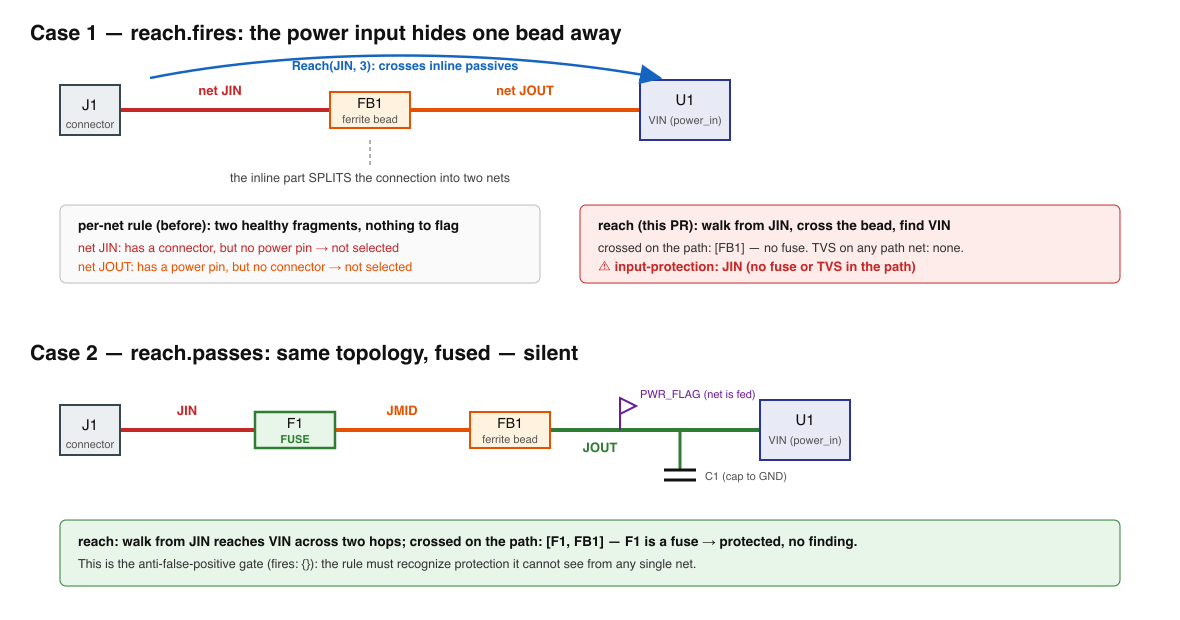
Since WS3-011 the rule walks: from each connector net it follows series pass elements (R/L/ferrite/fuse, the reach primitive, 3 hops) to find a power-input pin, and the path is protected if a FUSE was crossed to get there or a TVS hangs on any walked net up to it. Before the walk, a series element split the net and the rule saw nothing, so a fuse-protected board passed by accident, and an unprotected connector-bead-regulator path passed too (the false negative this upgrade closes). Fuse OR TVS satisfies the rule; a per-design “which protections are required” policy is rule configuration (WS3-006). Ground-named and unresolved external nets are skipped as before.
Query structure 
select connector nets whose reach finds an unprotected power input.
select N in nets where exists C in N.connections where class(C) == connector
  and exists M in reach(N, 3) where exists P in M.connections, pin_dir(P) == power_in
  and not (fuse crossed on path(N..M) or exists T on path nets, class(T) == tvs)
Reads: component.class, net.attributes (external), net.names (the ground-name skip), on_net, pin.electrical_type, reach. Tier R.
For software readers 
A schematic is a graph: components are nodes with named pins, a net is a hyperedge joining pins that are wired together. The concepts this rule leans on:
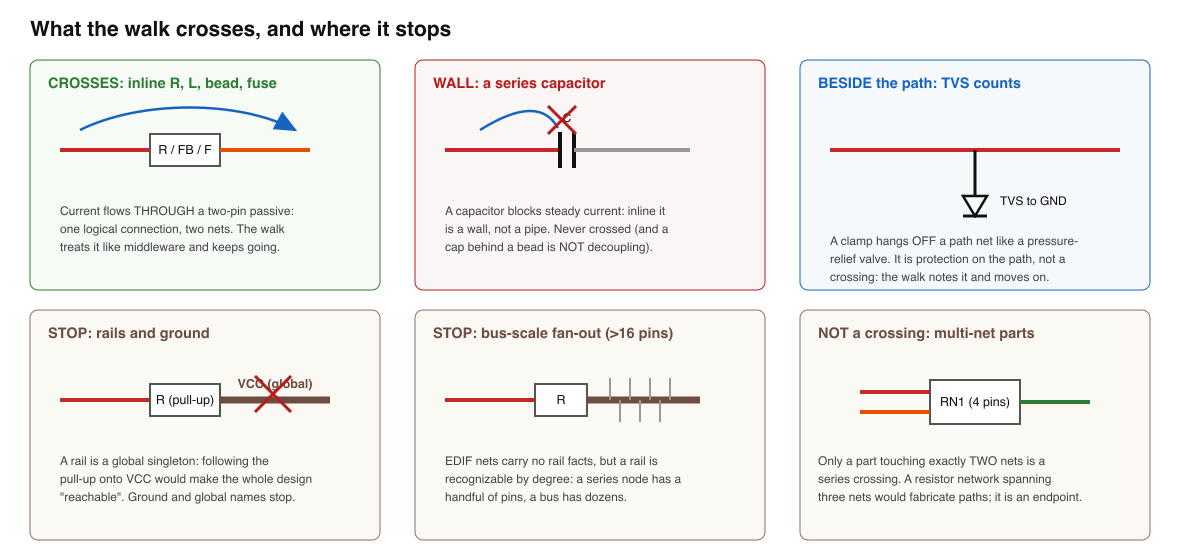
- Series (“pass”) element: a two-terminal part wired INLINE, like middleware in a request pipeline. Because a net is “everything directly touching”, an inline part SPLITS one logical connection into two nets, leaving a per-net rule like a function that can only see its own local scope.
- Fuse: a sacrificial circuit breaker, wired inline. “Is there a fuse between the wall plug and the machine” is a PATH question, like “does any middleware in the chain do auth”.
- TVS diode: a surge protector hanging OFF the path to ground like a pressure-relief valve; it is protection on a path net, not a crossing.
- Ferrite bead: an inline noise filter, electrically transparent here, and the classic innocent reason a power path is split into two nets.
- Rail (VCC, GND): a shared supply net like a global singleton; the walk never crosses into one.
The two conformance fixtures, drawn:
The walk’s crossing and stopping rules at a glance: