intent/protection-discharge
A rail the design intent declares needs a discharge path has no bleeder resistor.
Remedy 
Fit a bleeder resistor across the rail, sized so the rail discharges within the time the design assumes when it powers down.
What it means 
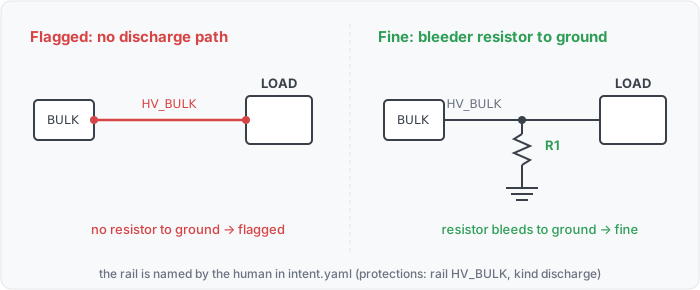
The design intent declares that a named rail must have a discharge path: a bleeder resistor that bridges the rail to ground so stored charge drains when the supply is removed. This rule fails when the declared rail carries no such resistor. It probes that exact net for a component that is a resistor AND also touches a ground net, and a declared rail with none is flagged.
Why engineers want it 
A rail with bulk capacitance stays energized after power-down. A bleeder gives it a defined, intended discharge path so the rail is safe to touch and predictable on the next power cycle. Which rails need bleeding is an architecture decision the netlist does not state, so the intent declaration names the rail and this rule verifies the resistor-to-ground is present.
Impact 
A rail the design was intended to discharge holds charge after power-down: a shock or arc hazard on a high-voltage rail, or unpredictable power-sequencing on the next cycle because a capacitor never bled down.
Scope note 
discharge is realized by a resistor that also reaches a ground net (name-derived ground, the same
predicate the net.ground fact uses). It is one of the per-kind protection rules
(intent/protection-ovp, intent/protection-discharge), each emitted only when the declaration
carries that kind. The rule iterates the declared protections and probes the design; it never derives
the protected-rail set from the netlist.