led-polarity
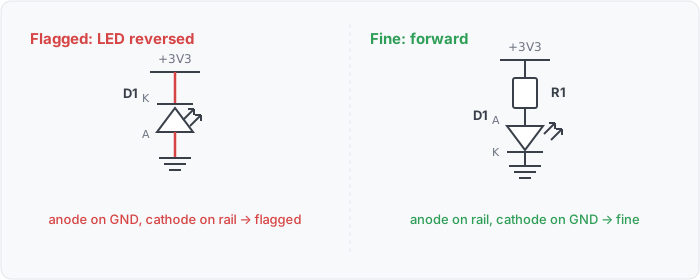
An LED's anode sits on ground and its cathode on a power rail, mounted backwards.
Remedy 
Swap the LED’s anode and cathode connections so the anode faces the supply side and the cathode the return path through its series resistor.
What it means 
An LED whose anode pin lands on a ground-named net while its cathode lands on a power-rail-named net. Current would have to flow from ground to the rail; the LED never conducts.
Why engineers want it 
LED polarity is the classic capture slip: the symbol is symmetric-looking, the footprint is not, and the netlist connects fine either way. Every review checklist has “check LED orientation” precisely because no electrical check catches it: both pins are properly wired, just to the wrong ends.
Impact 
A dead indicator discovered at bring-up; rework if the footprint is not hand-flippable.
Pin roles are derived, not stated 
No format carries polarity as data (KiCad LED pins are electrically passive; “A”/“K” are pin names), so the anode/cathode roles come from the name convention gated by device class, via pin.role, the same projection posture as component.class. An LED whose pins carry no recognizable names yields RoleUnknown and the rule stays silent (never guess).
LED-only, on purpose 
A zener or TVS wired cathode-to-rail is correct usage; the general diode-orientation rule needs net-polarity facts and is tracked with the WS3-003 corpus row, not here.
Query structure 
select LEDs whose role-resolved pins land on opposing rails.
select C in components where class(C) == led
  and ground_name(net_of(anode(C))) and rail_name(net_of(cathode(C)))
Reads: component.class, net.names, on_net, pin.role. Tier R.