netclass-track-width
A net is routed narrower than the track width its own net class declares.
Remedy 
Widen the track to the width its class declares, or amend the class if the declaration is the half that is out of date. The board may build either way, so decide which of the two states the design’s intent.
A net is routed narrower than the track width its own net class declares.
What this checks 
The project’s net_settings states, per net class, the track width that class’s nets are meant to
route at. This compares each net’s thinnest routed segment against that declared width and reports
the nets that fall short.
There is no number in this rule. The limit comes entirely from the design.
How it differs from track-width 
They look similar and answer different questions.
track-width asks can this be built: it compares copper against a universal fabrication floor
(0.127mm) that no mainstream process goes below. A finding there means the board may be rejected at
order time.
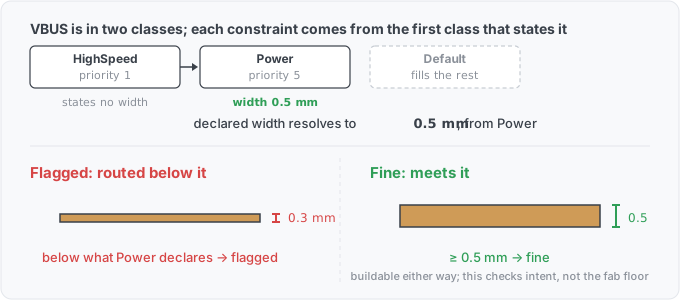
This rule asks is this what you asked for. It compares copper against the project’s own stated intent. A finding here can sit on a board that manufactures perfectly well: a power net declared at 0.8mm but routed at 0.3mm is buildable and is still wrong, because the 0.8mm was chosen for current and heat.
A net can pass one and fail the other, in both directions.
Resolving the declared width 
A net can belong to several classes at once, and this is where a naive implementation goes wrong.
KiCad does not pick one of a net’s classes and use it wholesale. It fills each constraint from the
highest-priority class that states that constraint, and the Default class supplies whatever is
left over. Default applies to every net, including nets in no class at all. So a net in a
high-priority class that declares only a clearance still takes its track width from the next class
down, and a net in no class still has a width it is expected to meet.
Comparing a net’s copper against every class it belongs to would fail nets that correctly obey the class that won. The rule resolves the cascade first, then compares once, and the finding names the class the limit came from.
Hardware context (for software readers) 
- Net class: a named group of nets sharing routing constraints. Structurally a tag set used as a policy scope.
- Track width: how wide the copper trace is. Wider carries more current and runs cooler; on a controlled-impedance net the width is part of what sets the impedance.
- Why the declared width matters: it encodes a decision someone made about current, heat, or impedance. Routing narrower silently discards that decision.
Absence is not a pass 
The rule declares CapNetClassDefs. A design that declares no net-class definitions has no limit to
compare against, so the rule reports not-applicable rather than running over zero comparisons and
reading clean. Only a KiCad project read supplies definitions; an EDIF netlist, an IPC-2581 board and
a bare .kicad_sch all leave them empty.
The rule is also silent on a net with no routed copper, since there is nothing to measure.