netclass-via-drill
A net's via is drilled smaller than the drill its own net class declares.
Remedy 
Enlarge the via drill to the size its class declares, or amend the class if the smaller drill is intended. The class carries an assumption about current capacity or plating, and one of the two has moved.
A net’s via is drilled smaller than the drill its own net class declares.
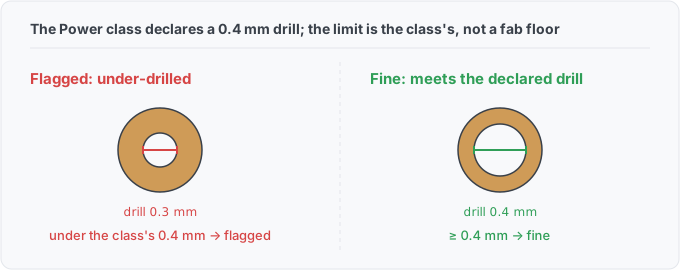
What this checks 
The project’s net_settings states, per net class, the via drill that class’s nets should use. This
compares each net’s smallest routed via drill against that declared drill and reports the nets that
fall short.
There is no number in this rule. The limit comes entirely from the design.
How it differs from hole-size 
hole-size asks can this be drilled: it compares via drills against a universal mechanical-drill
floor (0.2mm). A finding there means the fab cannot make the hole, or will silently upsize it.
This rule asks is this what you asked for. A class’s declared drill is usually sized for the current the class carries or for the process the board was quoted against. A via below it is often perfectly drillable, and still discards the reason the number was chosen.
Resolving the declared drill 
A net can belong to several classes at once, and this is where a naive implementation goes wrong.
KiCad does not pick one of a net’s classes and use it wholesale. It fills each constraint from the
highest-priority class that states that constraint, and the Default class supplies whatever is
left over. Default applies to every net, including nets in no class at all. So a net in a
high-priority class that declares only a track width still takes its via drill from the next class
down, and a net in no class still has a drill it is expected to meet.
Comparing a net’s vias against every class it belongs to would fail nets that correctly obey the class that won. The rule resolves the cascade first, then compares once, and the finding names the class the limit came from.
Hardware context (for software readers) 
- Via: a plated hole connecting copper on different layers. The drill is the hole diameter before plating.
- Why the declared drill matters: a bigger drill carries more current and plates more reliably. A class that declares one has usually done that sizing deliberately.
Absence is not a pass 
The rule declares CapNetClassDefs. A design that declares no net-class definitions has no limit to
compare against, so the rule reports not-applicable rather than running over zero comparisons and
reading clean. Only a KiCad project read supplies definitions.
The rule is also silent on a net with no vias, since there is nothing to measure.