output-output-conflict
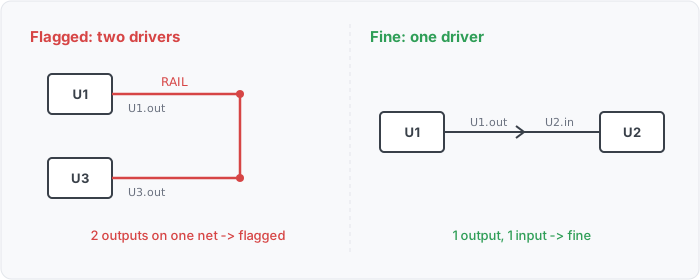
Two or more driving pins (outputs / power sources) share a net and fight each other.
Remedy 
Remove all but one driver from the net, or make the drivers arbitrate: series resistors, open-drain outputs sharing one pull-up, or a buffer whose enables are never asserted together.
What it means 
A net with two or more pins that actively drive it, whether signal outputs or power sources. A net may have at most one hard driver; two of them fight.
Why engineers want it 
It is one of the ERC pin-type-matrix’s flagship errors (output ↔ output). It happens when two blocks are wired to the same node by mistake, a bus is drawn without tri-state enables, or two regulators land on one rail. The symptom is contention current: the net sits between levels while both drivers source into each other.
Impact 
Contention burns power and can destroy the output stages; the logic level is undefined.
Scope note 
Counts hard drivers only, meaning outputs and power-outputs. Bidirectional (INOUT) pins are not counted: a shared bus of bidirectional pins is legal, and flagging it is the false positive that makes engineers mute the rule. Pin roles come from the reader’s electrical types; a design whose reader does not type pins does not fire. This is a row of the connection matrix (rule_pin_matrix.go); the pairing subsumes output ↔ output, output ↔ power-out, and power-out ↔ power-out.
Drivers are counted per COMPONENT, not per pin 
A power device commonly drives one net through several paralleled output pins (the real corpus: one driver IC, six output pads on one net), which is one driver electrically. Two-plus driving pins of the SAME component never fire; two different components’ outputs do. This surfaced the moment EDIF pin keys joined physically (WS1-025) and is why the count lives behind the driving_components FFI: distinct- count is not (yet) an AST shape.
A wired-OR bus is not contention 
An open-drain bus (a shared interrupt, inhibit, or reset line) has several devices whose outputs only pull to one level, with a pull resistor setting the idle level. That is intentional, not two drivers fighting. EDIF types open-drain pins plain “output”, so the tell is the PULL RESISTOR: a multi-driver net that carries a resistor and NO power-source (POWER_OUT) driver is treated as a wired-OR bus and stays quiet. The resistor is matched by PRESENCE, not by where it pulls to, because a real pull runs through several elements to an auto-named rail or to ground. The power-source exclusion is load-bearing: two power sources on a rail fight even with a bleeder resistor present, so a POWER_OUT driver keeps the rule firing.
Query structure 
select the nets driven by two or more distinct components, excluding wired-OR buses.
select N in nets where count(distinct component(P) : P in N, hard_driver(P)) >= 2
  and not (has_resistor(N) and not any(power_out(P) : P in N))
Reads: on_net (the net’s members), pin.electrical_type, component.class (the resistor pull). Tier R.