pin-net-conflict
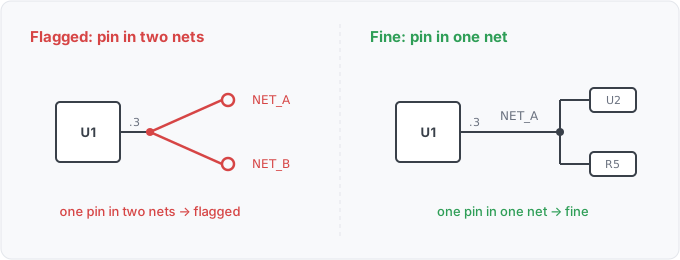
A pin appears in more than one net's connections, which is malformed input.
Remedy 
Fix the source netlist so the pin appears in exactly one net, then re-export. The ambiguity is in the input, so nothing downstream can resolve it.
What it means 
One (component, pin) appears in the connection lists of two or more nets. A net is the equivalence class of electrically joined pins, so membership is many-pins-to-one-net by definition; multiple membership is malformed input from a reader bug or a corrupt export rather than a design error a person drew.
Why engineers want it 
They should rarely see it. It exists as the integrity tripwire behind every per-pin net question the engine answers (pin.role consumers, diff keys, viewer highlights): when the invariant breaks, this fires instead of every downstream answer silently becoming arbitrary. PinNetName documents that it reports the first net in design order; this rule is why that arbitrary pick is safe. A firing points at the READ, not the design: its first corpus run surfaced two reader gaps (unannotated placeholder refs merged, WS1-024; duplicate port designators collapsed, WS1-025).
Impact 
Without the tripwire, an inconsistent netlist degrades every derived answer quietly. With it, the file is flagged at check time with the claiming nets named.
Severity is info, deliberately 
Both known producers of this state are reader gaps (WS1-024, WS1-025), so today a firing points at the tool’s read of the file, not at the design, and flagging it louder would blame the engineer for our keying. Revisit via severity configuration (WS3-006) once the reader fixes land and a firing is anomalous again.
Two deliberate suppressions 
A duplicated ref-des produces this state mechanically, since each colliding placement brings its own copper, so their shared (ref, pin) key lands in several nets. That root cause is duplicate-ref-des’s finding; pins of collided ref-des are skipped here so one authoring slip yields one finding, not two. (Found on the sheetnav conformance fixture the moment this rule first ran: the tripwire works, it just caught prey that already had an owner.)
The second is an UNANNOTATED ref-des: R?, C?, REF**, or a partly-assigned
C?1845. This rule asserts something about a PIN, and (R?, 1) does not name one: on one
export 176 distinct un-annotated resistors shared that key, so the index saw a single pin
sitting on 129 nets and 77% of this rule’s findings on that design described a netlist that
was fine. The design is not malformed; the key is not a key. Declining to assert uniqueness
over a non-identity is not the same as hiding a defect, and the un-annotated parts are a
finding in their own right rather than a silence.
Query structure 
report each conflict the model collected.
select P in pin_net_conflicts
  where not ref_des_collided(P) and not ref_des_unannotated(P)
Reads: pin.on_net, ref_des_collision (the suppressions). Tier P.