power-input-not-driven
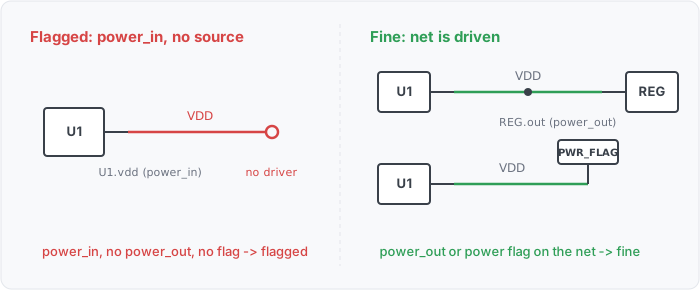
A power-input pin sits on a net with no power source (no power-output and no power flag).
Remedy 
Connect the supply pin to the rail that feeds it, and check that the rail itself reaches its regulator. An undriven VDD is usually a missed wire rather than a missing supply.
What it means 
A net that has a power-input pin (a VCC/VDD/rail-consuming pin) but no power source: no power-output pin and no power flag asserting the rail is fed elsewhere.
Why engineers want it 
This is KiCad’s ERCE_POWERPIN_NOT_DRIVEN, and the reason power flags exist. A rail is often drawn as a named net (+3V3) with the regulator on another sheet; capture tools cannot see the source without either a power-output pin on the net or an explicit flag. A power-input with neither is almost always a real omission, where the rail was named but never connected.
Impact 
The part (or a whole supply domain) is unpowered. It is one of the highest-consequence capture errors and only shows up at first power-on.
Scope note 
Needs the power-in / power-out split (a reader that collapses both to a generic power pin cannot distinguish source from sink, so the rule does not fire). A power flag on the net, recorded by the reader, counts as driven.
Concretely, the rule is gated OFF on a source format that does not type power OUTPUTS. EDIF’s port
grammar carries only INPUT/OUTPUT/INOUT and IPC-2581 is a board format with no pin electrical types
(the design.types_power_out fact). There a rail’s driver reads as a plain input, so “no power source”
would false-fire on every switched or derived rail. WS3-072 PR2 stamps the power-INPUT side so the
power-in-only rules (decoupling-present, input-protection) work on EDIF; this rule waits for the
symmetric power-OUTPUT stamp (PR3) before it can run there soundly.
Query structure 
select nets with a power-input, no driver, and no power flag.
select N in nets where any(power_in(P)) and not any(driver(P)) and not power_driven(N)
Reads: net.attributes (power_driven, external), on_net, pin.electrical_type. Tier R.