resonator-redundant-load-caps
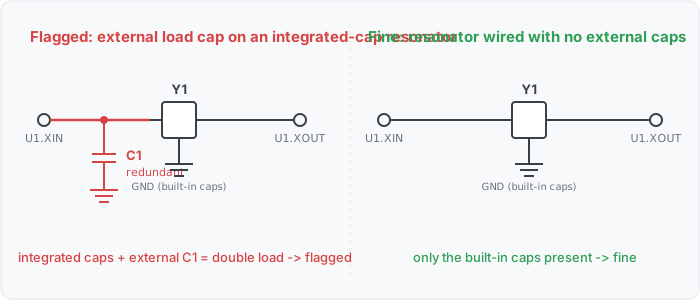
A ceramic resonator with integrated load capacitors also has an external load cap to ground on a terminal.
Remedy 
Remove the external load capacitors. A resonator of the built-in-cap family carries its own, so the schematic should show the resonator alone.
What it means 
A ceramic resonator of the built-in-cap family (Murata CERALOCK and kin, ref-des Y) already
contains its load capacitors, so its oscillator terminals connect straight to the driver and
its center pin to ground. No external load caps are needed. This rule flags a resonator
terminal that carries an external load capacitor to ground: the “double load” mistake.
Why engineers want it 
The load a crystal or resonator sees sets whether it starts and at what frequency. A ceramic resonator with integrated caps is specified for that load already built in. Add external load caps to ground and the total load roughly doubles, well above spec, so the oscillator starts slowly, starts only over part of the temperature range, or runs off-frequency. Everything clocked from it drifts with it. It is a common carry-over when a crystal footprint (which does need the caps) is reused for an integrated-cap resonator, and it usually oscillates on the bench and fails in the field.
Impact 
Slow-start / no-start over temperature or off-frequency operation from an over-loaded resonator; timing-dependent field failures that pass bench bring-up.
Scope note 
The rule quantifies over ceramic-resonator COMPONENTS. The ceramic_resonator class is
datasheet-seeded (WS10-015): the classifier cannot tell a resonator from a crystal by tokens,
so an un-subtyped clock candidate is NOT treated as a resonator and this rule stays silent on
it (a crystal genuinely needs its caps, which crystal-load-caps checks). A capacitor is counted
as an external LOAD cap only when it sits on a resonator terminal net AND also reaches ground;
a coupling or series cap between two signals (not touching ground) is not a load cap and is not
flagged. Ground-named nets are the resonator’s center/case pin, not signal terminals. An
unresolved external net is skipped (its wiring may live on an unread sheet), matching the
crystal-load-caps external-skip convention. This rule checks the PRESENCE of a redundant cap,
not its value; the exact integrated-cap value is a datasheet-joined refinement (WS10), out of
scope here.
For software readers 
This is the mirror of crystal-load-caps. A crystal is a component with a required companion dependency (load caps) that must be present; a built-in-cap resonator is a variant that satisfies that dependency internally, so wiring the companion parts again is a redundant, and harmful, override of a default. The check is “this node has a dependency it should NOT have,” the negative of “this node is missing a dependency it must have.” We detect the resonator variant from its declared class (datasheet-seeded), not from a name, exactly as the active-XO skip in crystal-load-caps detects the self-satisfying variant structurally.
Query structure 
select ceramic resonators; for each non-ground, resolved terminal net, fire if a capacitor on that net also reaches ground.
ground_refs = { component | some pin on a ground net }
for Y in components where class(Y) == ceramic_resonator:
  for N in nets(Y) where not ground(N) and not external(N):
    if exists C in N.connections where class(C) == capacitor and C in ground_refs:
      FIRE(Y, N, C)
Reads: component.class, net.attributes (external), net.names (the ground skip and cap-to-ground test), on_net. Tier R.