symbol-unresolved
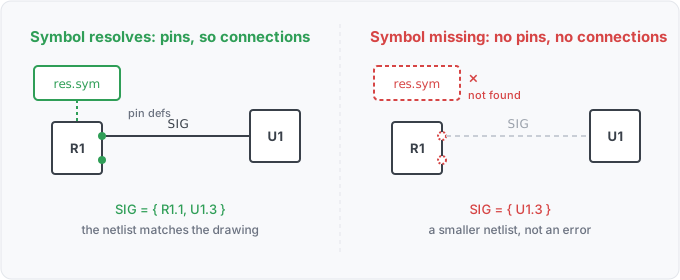
A symbol reference did not resolve, so its placements carry no pins.
Remedy 
Re-run with --symbol-path pointing at the library that holds the symbol. Until it resolves, the part has no pins, so every connectivity result over it rests on an incomplete read.
What it means 
A symbol reference the reader could not open or parse: an xschem or gEDA .sym file, or a KiCad
external .kicad_sym library named by a lib_id the schematic does not embed. The schematic itself
parsed fine. Only the file holding the part’s pin definitions is missing.
Why engineers want it 
A symbol carries a part’s terminals. When it fails to load, the placement keeps its reference designator and gains no pins, and a part with no pins has no connections. So the netlist is missing every connection those parts make, and nothing about the result looks wrong: the design reads as valid and simply emptier than it is.
That is the whole failure mode. A missing library does not produce an error, it produces a smaller netlist. Connectivity rules then run over the incomplete read and report a clean pass, which is indistinguishable from a design where those connections were never drawn.
Impact 
Every connection made by the affected parts is absent from the netlist. The reader compounds this by design: dangling-endpoint findings are suppressed whenever any symbol fails to resolve, because a missing pin turns a real wire end into a phantom dangle. Without this rule, the only visible effect of a lost symbol is that the design reports LESS than it would have.
What it does to other rules 
Any unresolved symbol gates every rule that reads a pin or connectivity fact to inconclusive for
the whole design, rather than letting it pass over an incomplete netlist. The gate is DESIGN-WIDE,
which is deliberately the conservative reading and matches what the readers already do with dangling
endpoints: one unresolved placement suppresses the whole design’s dangles.
Narrowing it to only the affected parts needs a mapping from a finding back to the ref-des it concerns, which does not exist yet. Until it does, a narrower gate would amount to asserting that the parts not flagged are unaffected, and the reader cannot support that claim.
inconclusive, not not-applicable: a missing source-format capability is permanent, while an
unresolved symbol is a property of THIS read that a --symbol-path away is fixable.
The one subtlety 
Warning severity, though the effect on the netlist is as corrupting as a ref-des collision, which is
an error. The difference is whose fault it is. A collision is an annotation slip in the design. An
unresolved symbol is almost always a defect in the invocation: no --symbol-path, a library not
checked out, a file not mounted. The board itself may be flawless, and every FAIL is supposed to be
a genuine defect.
Reading without symbols at all (the plain Read entry, no opener) reports nothing. That is a caller
deliberately asking for names-only, not a resolution failure.