test-point-coverage
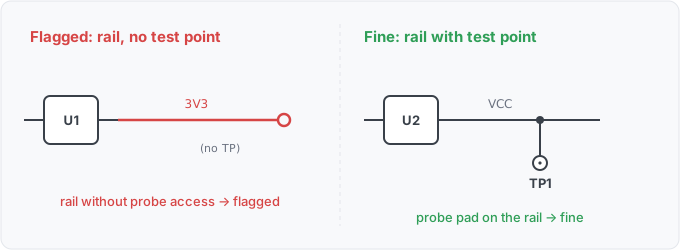
A power rail or ground net has no test point, on a board that uses them.
Remedy 
Add a test point to the rail. It costs a pad, and it is the difference between measuring a supply at bring-up and trying to hold a probe on a component lead.
What it means 
A power rail or ground net carries no test-point component, on a design that places test points elsewhere.
Why engineers want it 
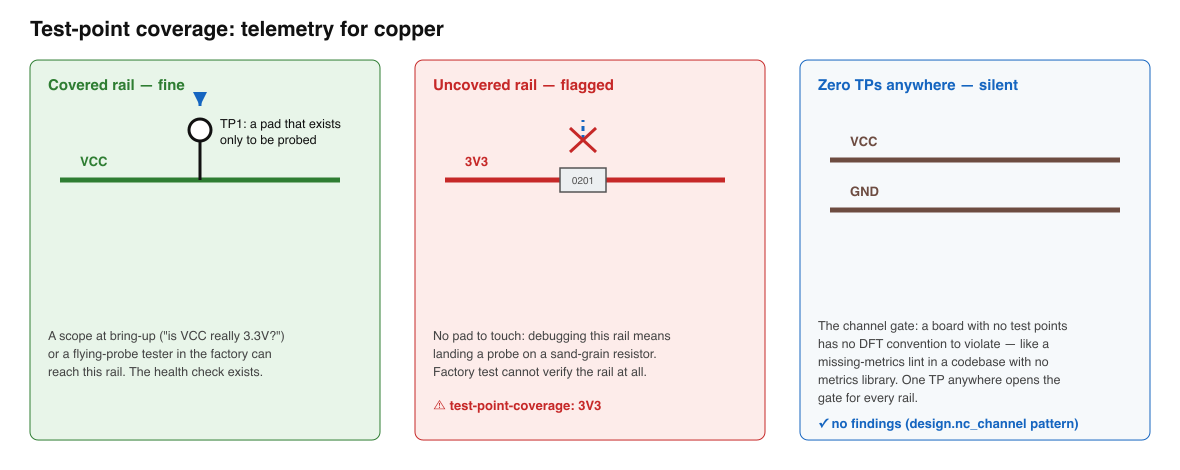
A test point is a dedicated probe pad: its only job is to expose a net so a scope probe (bring-up debugging) or a bed-of-nails / flying-probe machine (factory test) can measure it on the assembled board. DFT review checklists ask for the important nets, rails and ground first, to be probe-able; an unreachable rail is debugged by touching component pads the size of sand grains, and factory test simply cannot verify it.
Impact 
The nets you most need to observe when a board misbehaves are exactly the ones this rule covers: is the 3V3 rail actually at 3.3V, is ground clean, is the supply sagging under load. Missing coverage costs nothing at design time and everything at bring-up.
Scope note 
Gated on the DESIGN using test points at all (the design.nc_channel pattern): a board with zero TPs has no probe convention to violate, so small demo boards stay silent; a board with some TPs has declared the convention, making an uncovered rail an omission. “Rail” is the union of the rail FACTS (global, power_driven) and the rail / ground NAME heuristics, because name is the only rail evidence a directionless EDIF netlist carries. Cross-sheet (external) nets are skipped. Connector pins can also provide probe access in real DFT flows; counting them is a possible widening if the corpus shows the TP-only reading too strict. A regulator FEEDBACK / sense node reads as a rail by name (VCC…_FB) but is a high-impedance sense point that must not be probed (a test point would load the divider and shift the regulated output), so it is EXCLUDED (WS3-067); the feedback patterns are naming-lexicon config a project extends (WS3-069). Severity info: DFT posture is a per-project policy and the reviewer decides, the rule surfaces the genuine rails.
Query structure 
gate on the channel, select uncovered rails, excluding feedback sense nodes.
select N in nets where has_test_points(design)
  and (rail_fact(N) or rail_name(N.name) or ground_name(N.name))
  and not feedback_name(N.name)
  and not exists T in N.connections where class(T) == test_point
Reads: component.class, net.attributes, net.names, on_net. Tier R.
For software readers 
A test point is a metrics endpoint: a tiny component whose only purpose is observability. This rule is “every critical path must emit telemetry”, where a power rail without a test point is a service with no health check, fine until the day you desperately need to see inside it. The channel gate is the interesting part: the rule only fires on boards that instrument SOMETHING, the way a lint rule for missing metrics only makes sense in a codebase that has a metrics library wired up at all.