wire-no-junction
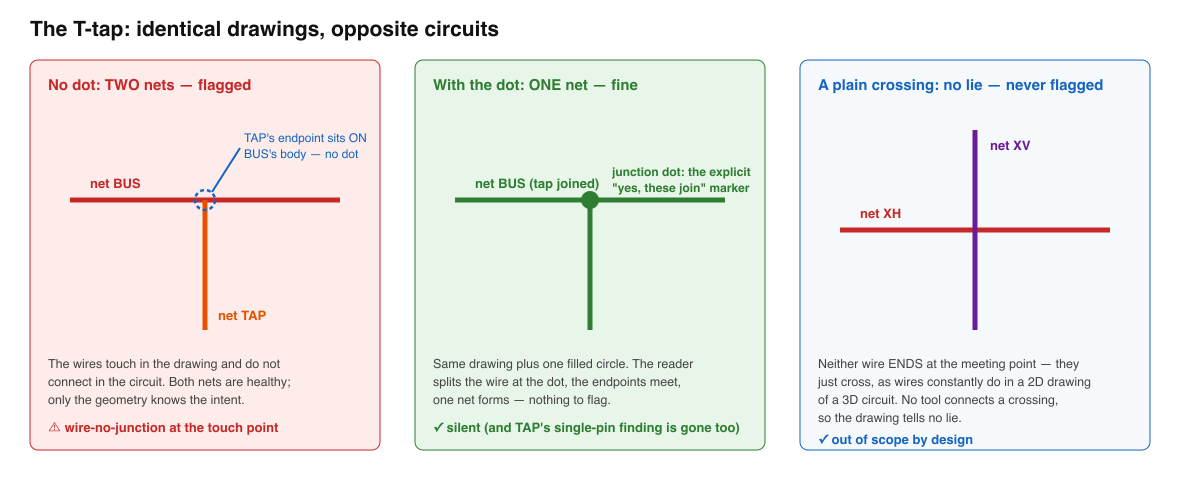
A wire endpoint lands mid-span on another wire with no junction dot.
Remedy 
Place a junction dot where the wires meet if the connection is intended, or move one wire clear of the other if it is not. Do not leave the crossing to be read by eye.
What it means 
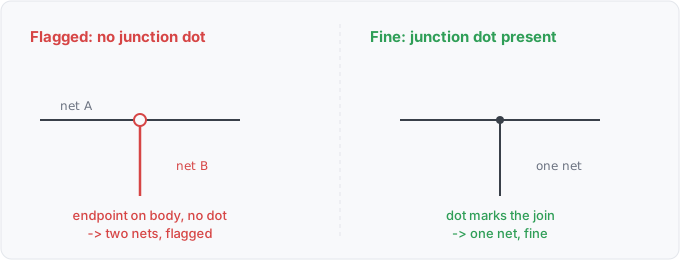
A wire’s endpoint lies strictly inside another wire segment’s body, and no junction dot (or label) sits at the touch point. KiCad connects wires only where a dot is placed, so the two wires are electrically separate despite touching on screen.
Why engineers want it 
This is the sibling of dangling-endpoint with the opposite disguise: a dangling end is visibly incomplete if you look closely, but an undotted T-tap looks EXACTLY like a connected one. The mistake survives visual review by construction and surfaces at bring-up as a missing connection between two otherwise-healthy nets.
Impact 
Net A and net B behave normally in isolation, and every net-level rule sees two well-formed nets, so nothing else can catch it. The drawing is the only witness, and the drawing lies.
Scope 
Endpoint-on-body only. Two wires that merely CROSS (no endpoint at the meet) never flag: KiCad does not connect crossings regardless, so the drawing tells no lie. A label at the touch point joins the wires by name (both attach to it) and the reader has already split the segment there, so labeled taps do not flag either. KiCad-family semantics: formats whose tools auto-connect T-touches (gEDA) never emit the diagnostic.
Query structure 
the reader computes endpoint-on-body from wire geometry after splitting at junctions and labels; the rule reports them.
select E in no_junction_endpoints
Reads: wire.endpoint, wire.junction. Tier P.
For software readers 
KiCad stores no connection list; connectivity is GEOMETRIC, so things connect where their coordinates coincide, the way whitespace-significant syntax gives meaning to layout. Two touching wires join only at endpoints or where the author placed a junction dot (the explicit “yes, these join” marker). A wire ENDING on the MIDDLE of another wire, with no dot, is a file that LOOKS imported because it sits in the right directory but was never added to the build: every human reads it as connected, the toolchain disagrees, and both halves are individually healthy so nothing else can reveal the gap.